The weekly review: twenty minutes on Sunday to start the week with a clear head
Twenty minutes on Sunday to clear the backlog, look back on your week and pick three priorities: the weekly review, step by step, without losing your evening.


Sunday, late afternoon. The new week hasn't started yet, and it already feels heavy: that email still waiting for a reply, Tuesday's meeting you haven't prepared for, the project that hasn't moved in three weeks. Nothing serious, but everything is floating.
That's exactly what the weekly review is for: turning the fog into a clear list, in about twenty minutes. David Allen made it one of the pillars of his Getting Things Done method, but you don't need to adopt the whole method to benefit from it. It's a short meeting with yourself, always at the same time, that lets you choose your week instead of putting up with it.
Why review every week
A day is too short to step back: you're head down in whatever needs doing. A month is too long: by the time you notice a project has drifted, it's already late. A week is the right scale, long enough to see patterns, short enough to change course.
In practice, a regular review gives you three things:
- It closes open loops. Everything lying around in your head, your inbox or your notebooks finds a home, or goes away.
- It shows what's really moving. Not what you feel you did: what you actually did.
- It lets you decide calmly. On Monday morning you already know where to start, instead of reacting to the first message that lands.
The setup: same time, same length
The review sticks if it becomes a habit, and a habit sticks if it's easy to start. Three simple rules:
- A fixed slot. Late Sunday afternoon works for a lot of people; others prefer Friday lunchtime, to wrap up the week before leaving. The day doesn't matter, as long as it's always the same. Block it in your calendar like a real appointment.
- A fixed length. Twenty minutes, with a timer. Without a limit, the review drags on, becomes a chore, and you end up skipping it.
- You decide, you don't do. The review isn't a catch-up session. If you come across a two-minute task, do it; otherwise, write it down and move on.
Five steps in twenty minutes
1. Empty (5 minutes)
Start by gathering everything that's lying around: notes on your phone, papers on your desk, emails flagged "to deal with", ideas going round in your head. Put it all in one place, then sort: each item becomes a task, a note, or goes in the bin. The goal is to start again from an empty inbox, so nothing is left floating.
2. Look back (4 minutes)
Go through what you finished this week, then what slipped. Answer two questions in a few words: what worked best? What held you back? No need for an essay, one line is enough. What matters is spotting the patterns: the meeting that eats every Wednesday, the task pushed back four times in a row, the evening you finally made progress.
3. Check the calendar (4 minutes)
First look at the week that's ending: did a meeting leave a follow-up, a call to make, a document to send? Write it down. Then look at the week ahead: appointments, deadlines, birthdays, trips.
Above all, spot your real free time. A week with three busy evenings doesn't have the same capacity as an empty one, and now is the time to know it, not on Thursday night.
4. Go through projects and goals (4 minutes)
For each active project, ask a single question: what's the next concrete action? Not "make progress on the move", but "ask three removal companies for a quote". A project with no next action is a stalled project, even if it's still on your list.
Finish with your longer-term goals. Did this week bring you closer? If the answer is no three weeks running, that's not a failure, it's information: either the goal isn't a priority any more, or it needs a real place in your schedule.
5. Choose (3 minutes)
Pick three priorities for the week, no more. These are the things that, if done by Friday, will make the week a success whatever else happens. Then put them on specific days, based on what the calendar told you.
An imperfect review you do every week beats a perfect one you never do.
The usual traps
- Reorganising everything. The review isn't the moment to switch tools, rename your projects or rebuild your system. It feels like progress, but nothing gets decided.
- Putting yourself on trial. Looking at what slipped is for understanding, not judging. If the same task has been slipping for a month, ask whether it's badly worded, too big, or simply not important.
- Too many priorities. Ten priorities is a to-do list. Beyond three, nothing is really a priority any more.
- Giving up after a skipped week. It will happen. Just pick it up again the following week, without trying to catch up on the one you missed.
The express version, for busy weeks
Some weeks, even twenty minutes feels impossible. Then keep the bare minimum, in five minutes: clear what's lying around, answer the two questions about the past week, and pick a single priority for the next one.
It's not much, but it keeps the thread going. And over time, the thread matters more than perfection: a quick review every week will teach you more than a big one every two months.
In Dandori
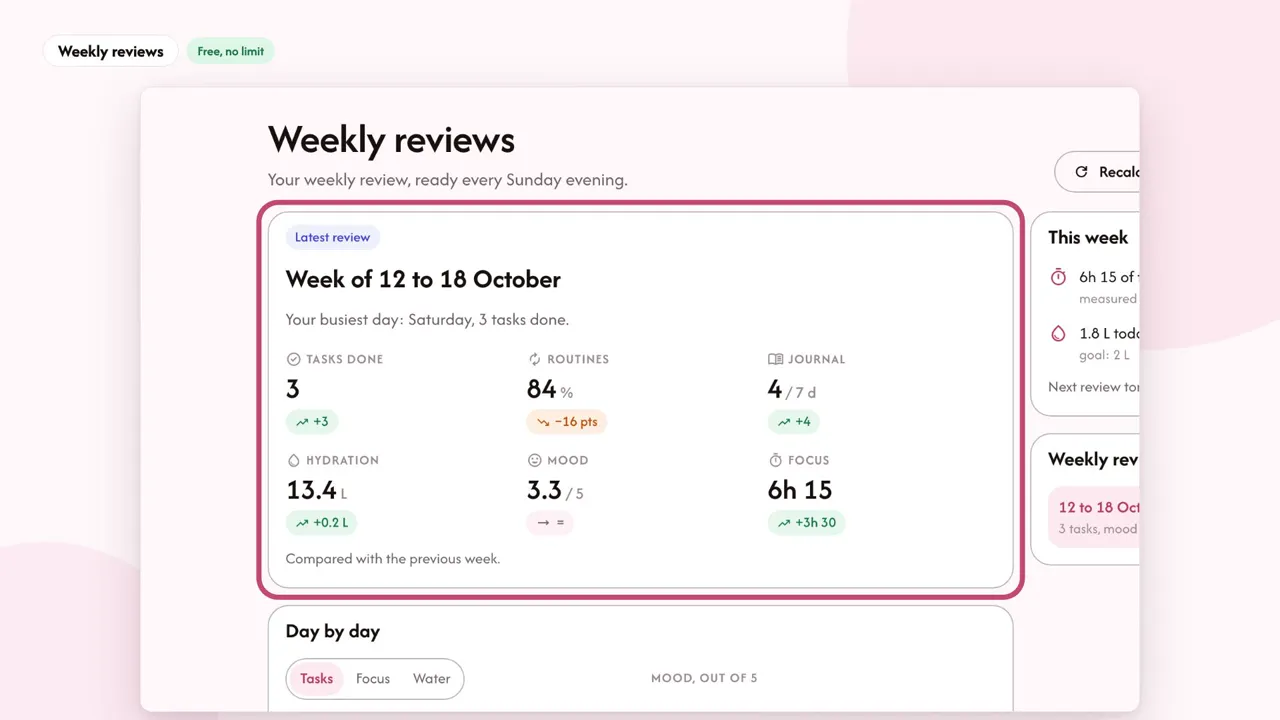
Dandori does a good part of the work for you. Every Sunday at 8 pm, a summary of your week is waiting in Weekly reviews: the tasks you completed, your focus time measured with the timer, your mood and your routines, compared with the week before, along with what went well and the things to watch that the numbers point to. All that's left is to read it, then answer the three questions in "Your reflection": what worked best, what held you back, and your priority for the week ahead.
For the rest of the review:
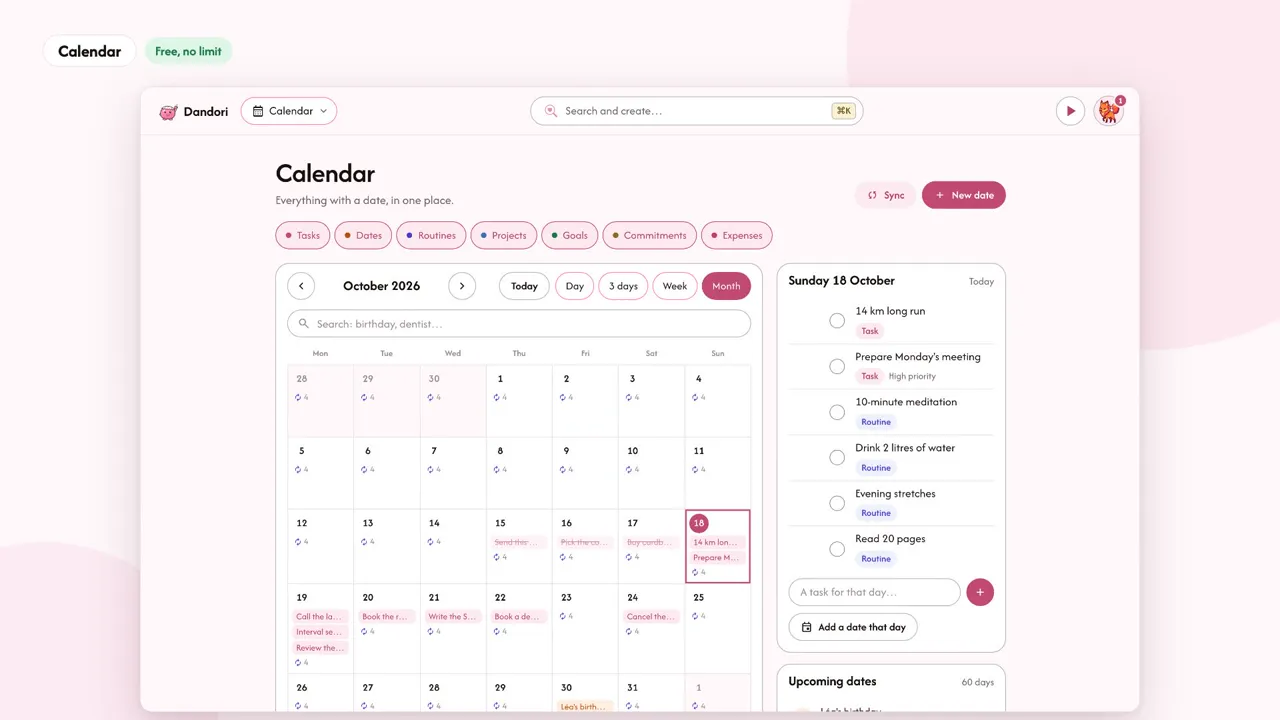
- Calendar: everything with a date in one place, tasks, routines, project and goal deadlines, important dates and recurring expenses.
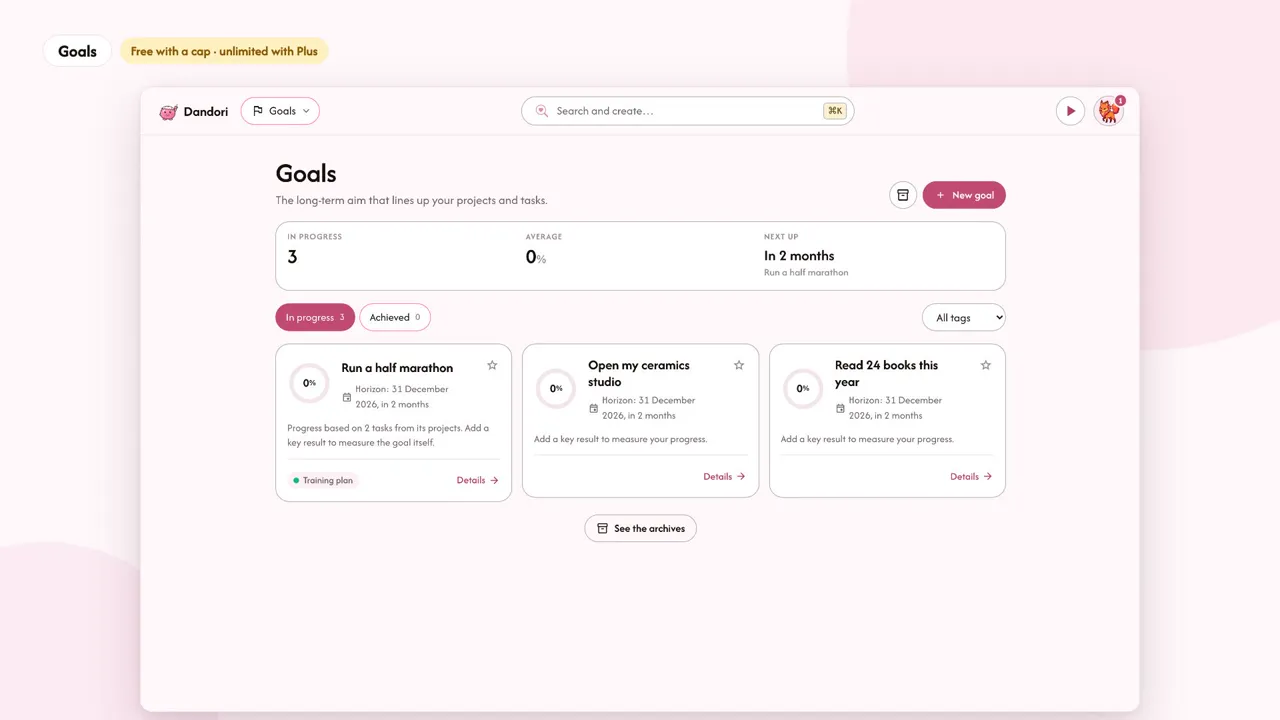
- Goals: the long-term course, linked to your projects and tasks, to check that your week is heading the right way.
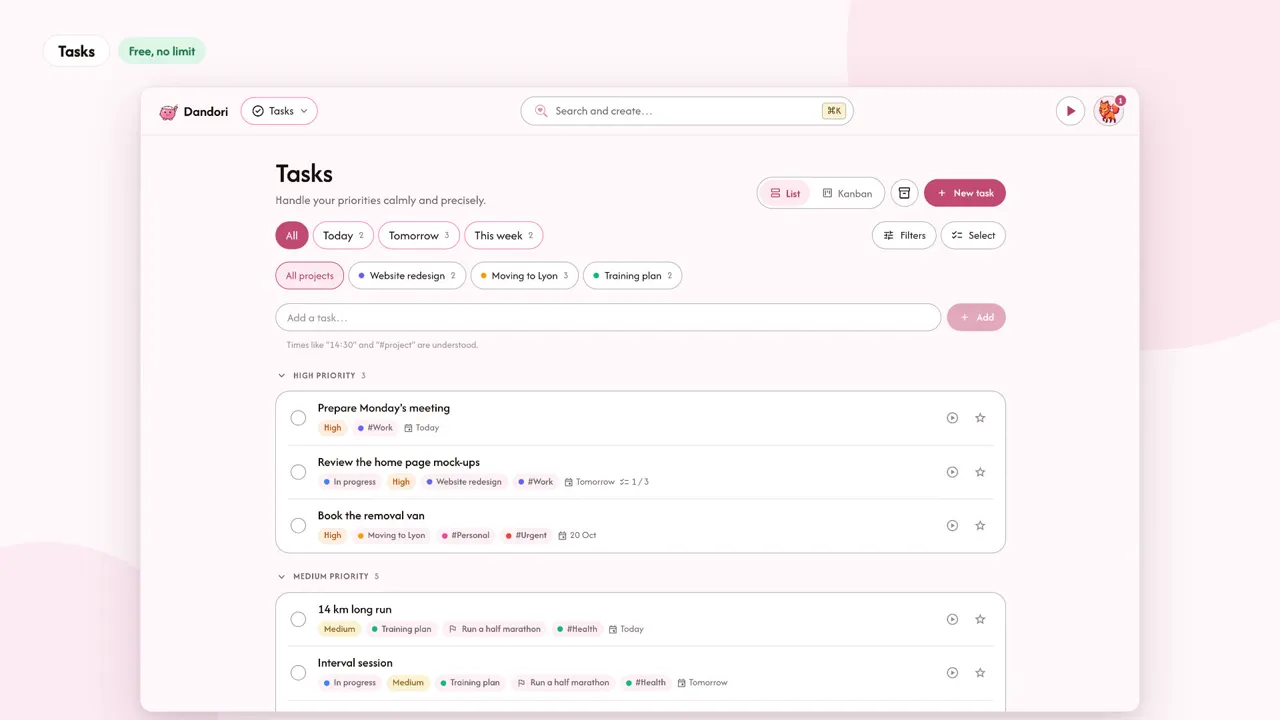
- Tasks: the "This week" filter to see what's coming, and multi-select to push several tasks back to Monday in one go.
If you've switched on AI with your own key (on the Plus plan), your review also gets a reading of your week every Monday, and you can ask it a question about what happened.