Sticking to a habit: the streak matters less than coming back after a miss
Missing a day doesn't ruin a habit, quitting after it does. Start small, track your consistency rather than your streak, and get back on track without guilt.


Forty-two days in a row. You've meditated every morning for six weeks, the little chain of ticked boxes keeps growing, and you're proud of it. Then one Tuesday the alarm doesn't go off, a child is sick, the train is cancelled. In the evening it dawns on you: the day went by without meditating. The counter drops back to zero.
The next day, a small voice whispers: "What's the point?" And that's often where a habit dies, much more than on the day you missed.
Why the streak ends up working against you
At first, counting days in a row is a fantastic motivator. Every ticked box feels good, and you don't want to break the chain. But the longer the streak gets, the more it changes nature: it becomes something to protect rather than something you enjoy. You're no longer doing the habit for yourself, you're doing it for the counter.
The problem shows up on the day you miss. A counter that resets to zero tells a false story: it says everything has to start over, as if the previous forty-two days never happened. Your body and mind kept those six weeks. But the disappointment is real, and it pushes you towards all-or-nothing thinking: since it's broken, you might as well stop.
What really matters: consistency
A habit isn't measured by consecutive days, but by the share of days it actually happens. Twelve days out of fourteen is a solid habit, even if your current streak is only three days. Thirty days in a row followed by giving up completely counts for less than a whole year at four days out of five.
James Clear describes each repetition as a vote for the person you want to become. It's a helpful picture: one missed vote doesn't change the result of the election. What counts is the majority.
So look at your consistency over a rolling period, two weeks or a month, rather than at your counter. It's a number that forgives a bad day and rewards coming back.
Start small enough not to need motivation
Motivation is fickle: strong on day one, gone by day ten. A good habit has to work without it. To get there, it needs to be small, almost ridiculously so:
- A minimum version. Read one page, not a chapter. Do five push-ups, not a workout. Write one sentence, not a page. You can always do more, but the minimum version is enough to tick the box.
- A precise trigger. "After my morning coffee, I read one page" holds up far better than "I'll read more". Attach the new habit to one you already have.
- Realistic days. A habit doesn't have to be daily: running three times a week is a habit. Planning seven days and managing four means three failures a week; planning four and keeping them is a success.
The two-day rule
A simple rule has been around for a long time among people who think about habits: never miss twice in a row. One missed day is an accident. Two missed days is the start of a new habit, the habit of not doing it.
This rule changes how you experience a miss. On the day you skip, the question is no longer "did I fail?" but "what do I do tomorrow?". And the answer is always the same: the minimum version, no negotiating.
Plan for the miss before it happens
Misses don't come out of nowhere. They almost always happen in the same situations: travel, illness, crunch weeks, weekends. You may as well plan for them:
- A backup version. For hard days, decide in advance what still counts: one minute of breathing instead of ten of meditation, a walk instead of a run.
- A deliberate pause. On holiday, or during a week of illness, pause the habit rather than missing it every day. A pause you choose breaks nothing; a string of misses you didn't choose does.
- Your weak spot. If you always miss in the evening, maybe the habit is at the wrong time of day, not that you lack willpower.
Coming back after a miss, or a long break
You've missed a day, a week, or three months. Here's how to restart without sabotaging yourself:
- Don't compensate. No double session to catch up. Coming back too hard sets you up to quit again.
- Restart from the minimum version. Even if you used to do much more. The first few days are about getting the machine running again, not getting back to your old level.
- Look for the cause, not someone to blame. What went wrong: a schedule, a context, a habit that was too ambitious? Adjust the habit, not your self-esteem.
- Watch your consistency, not your counter. It starts climbing from the first day back.
The day that matters most isn't the hundredth in a row: it's the one where you start again.
In Dandori
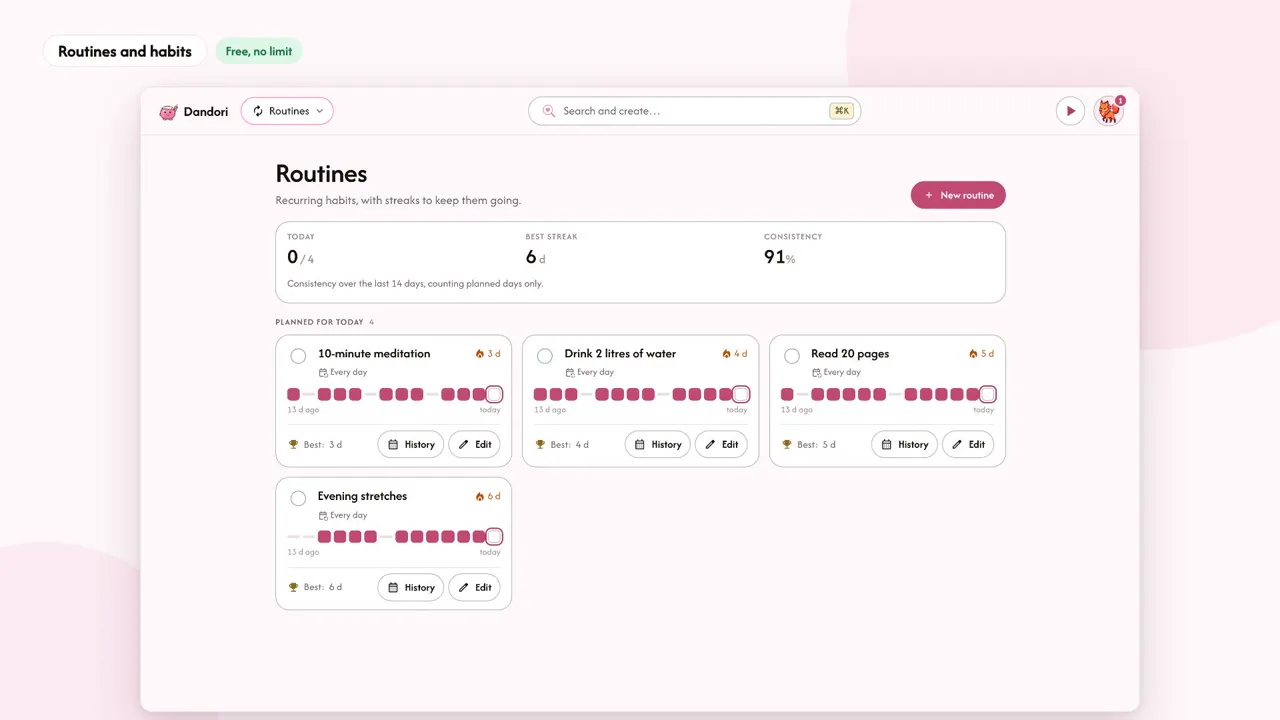
That's what Routines are for. Each routine can be planned every day, on some days of the week or once a month, as a simple habit to tick or as steps to follow in order. Next to your best streak, Dandori shows your consistency over the last fourteen days, counting planned days only: a day when the routine isn't planned doesn't count against you.
A few ways to put the method into practice:
- Pause a routine while you're on holiday: it's no longer planned or counted in your consistency.
- Tick a past day if you did the habit but forgot to log it.
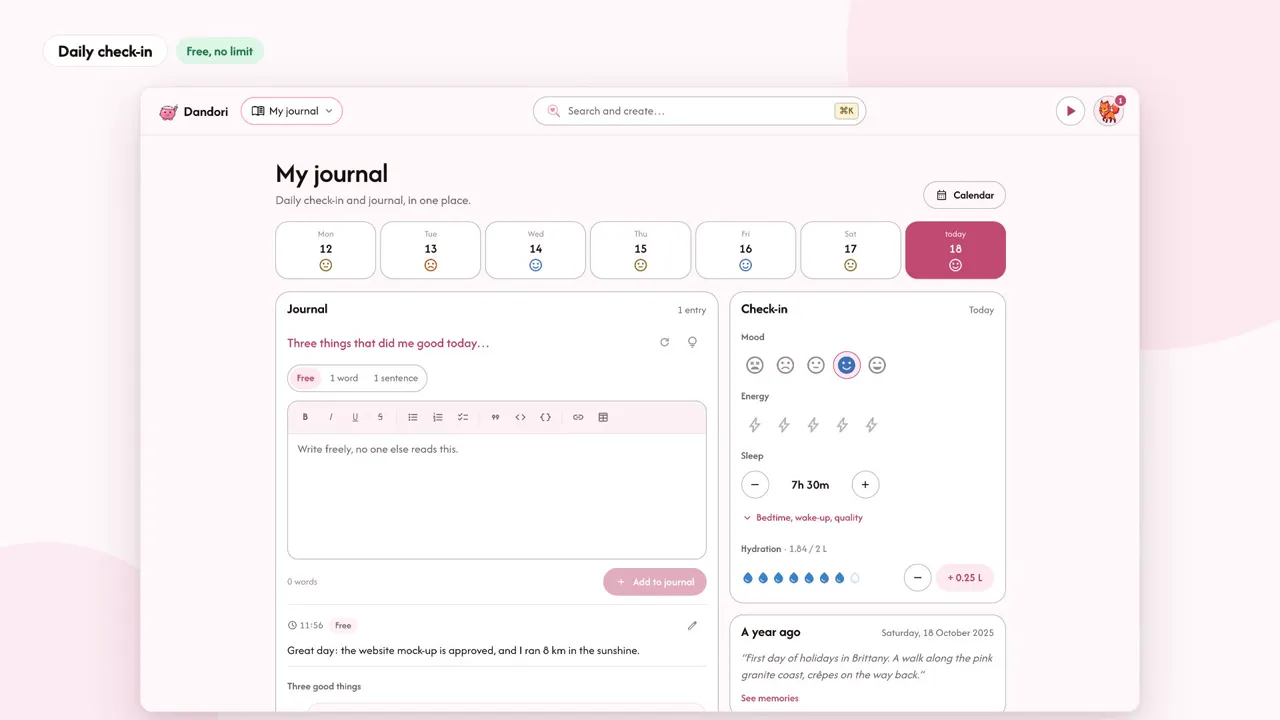
- Start with My journal: the daily check-in (mood, energy, sleep) and one word or one sentence for your day make an ideal first habit, done in a minute.
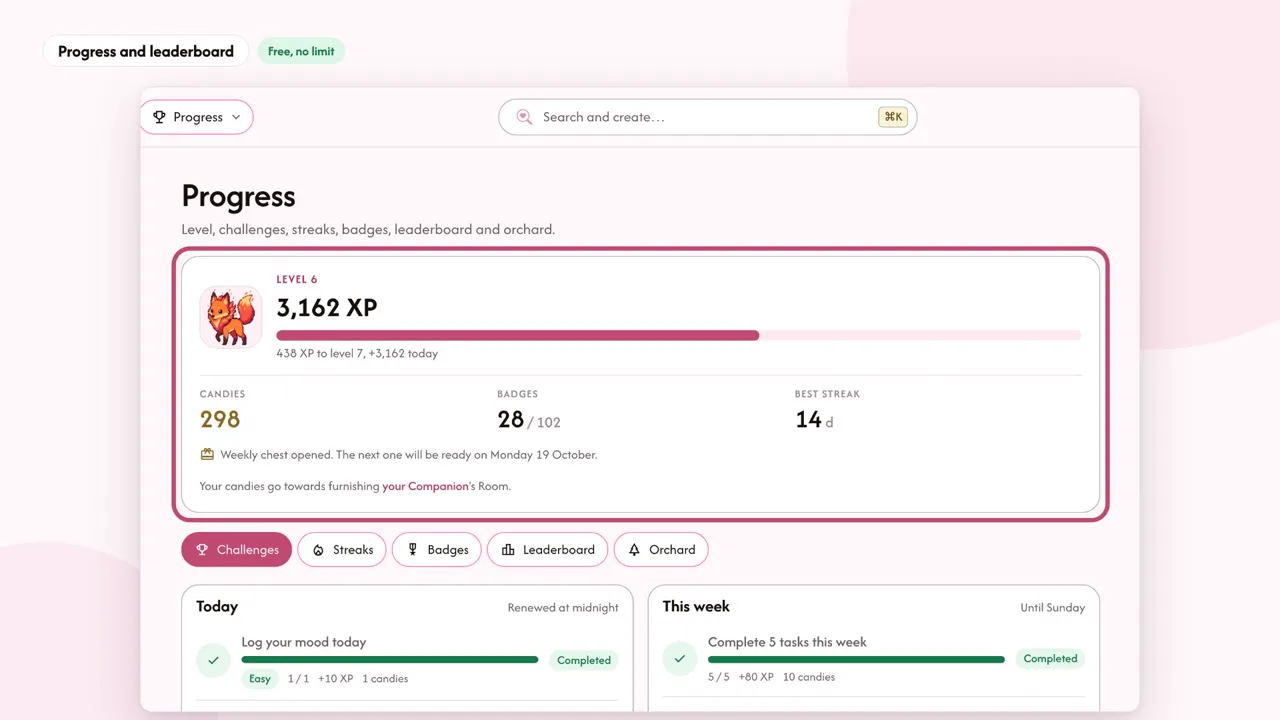
Over in Progress, every task, routine or journal line earns you XP, and a weekly streak freeze saves your streak if you miss a day. Your Companion grows with your habits and never dies: neglected, it goes off on a trip, and it comes back as soon as you pick things up again. Exactly the spirit of this article.